Friday, September 26, 2014

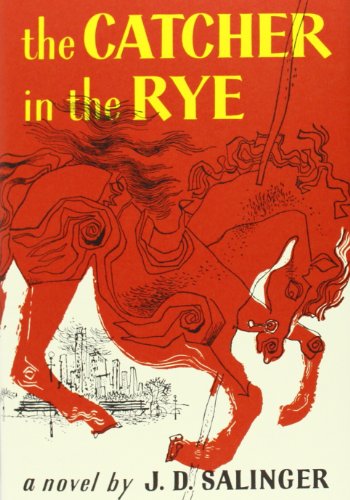
The Catcher in the Rye by J. D. Salinger #3 - Finished

          This week I finished the book The Catcher in the Rye. In the last third of the book, the main character Holden begins to express signs that he's scared about his future. Holden spends the remaining pages trying to find himself, but he still feels lost. While out on a date with his friend, Holden decides to leave his home and essentially run away. He wants to escape his problems, and simply go to some place where he can get a fresh start.

          Although Holden never actually describes himself as lost, one can infer that he is still trying to find who he is. Throughout the story he describes most characters, mainly adults, as "phonies". Holden seems to truly consider only himself and his sister to be anything other than fake. While acknowledging this point, the reader could infer that Holden is trying to convey that he doesn't belong in this society, and that this is not the identity he wanted for himself. One could also understand that Holden considers becoming a phony to be part of growing up. This may be why he is reluctant to do so. On many occasions, Holden mentions how his brother D. B. became a "sellout" when he grew up and became a writer. This personal experience may explain Holden's pessimistic view of growing up.

          When Holden was asked by his sister Phoebe about what he wanted to become, his response was a very pivotal moment in the story:

"What I have to do, I have to catch everybody if they start to go over the cliff--I mean if they're running and they don't look where they're going I have to come out from somewhere and catch them. That's all I'd do all day. I'd just be the catcher in the rye and all. I know it's crazy, but that's the only thing I'd really like to be. I know it's crazy," (Salinger, 93).


       In the lines stated above, one can truly see that Holden Caulfield is a lost soul. He sympathizes with those in similar situations, and has decided that he'd want to help. Similar to the people Holden described in the quote, he is also someone who is running without looking. He is simply getting by in life, but has no idea where his path may take him.  

          Overall I enjoyed this book, and I found the stream of consciousness structure to be different and refreshing, since it is not seen often in the books I read. I also liked how a reader could interpret the central message in many different ways. It all depends on which inferences they made. For example, this link takes you to an article on analyzing the reason why Holden is the way he is. 


Friday, September 19, 2014

The Catcher in the Rye by J.D. Salinger #2

          This week I continued reading J.D. Salinger's The Catcher in the Rye. As I read, I noticed that most of the story is found in the main character, Holden's memories. The story itself takes place in the span of a few days, but Salinger adds more depth by describing Holden's past through the narration of his memories.

          The main character Holden Caulfield reminds me of Charlie from Stephen Chbosky's The Perks of Being a Wallflower. Both Holden and Charlie seem to be very indifferent towards things usually filled with more excitement. In Chbosky's novel, other characters even tell Charlie that he is a wallflower. In The Catcher in the Rye this characterization is more subtle, and told through Holden's thoughts, actions, and words. This characterization is also realized since Holden seems to always be lost in thought. A key difference between the two characters is that Holden seems to reject society, and desires one more suited to him. He is extremely introverted, and perceives society to be filled with 'phonies'. Charlie on the other hand seems to find himself naturally fitting in with a crowd of outcasts. They face similar struggles, but have different approaches when it comes to dealing with them.

          I am a third of the way through the book, and I'm finding the story to be very interesting. There is no real action, since the conflict is more internal than external. Holden often refers back to the death of his older brother Allie. Through this the reader can recognize that Holden is still coping with Allie's death, and seems to be coping with growing up in general.


Friday, September 12, 2014

The Catcher in the Rye by J. D. Salinger #1

          Recently I have started the book The Catcher in the Rye. The plot has not developed yet, but the introduction seems interesting. The main character, Holden Caulfield is an apathetic teenager who is kicked out of his fourth school. He believes that this is all just a phase, and that everything will turn out okay, but his history teacher Mr. Spencer thinks differently. Holden's main problem is that he doesn't apply himself, and he believes that everything is too 'phony'. So far the story is a narration of life through a teenager's perspective.

          Salinger does an amazing job with the characterization. He clearly depicts the character without having to literally state a description. In the following lines Holden is describing his brother D. B. They are an example of how Salinger uses slang terms and basic vocabulary to express the thoughts and feelings of a teenager:

          "He's in Hollywood. That isn't too far from this crumby place, and he comes over and visits me practically every week end. He's going to drive me home when I go home next month maybe. He just got a Jaguar. One of those little English jobs that can do around two hundred miles an hour. It cost him... near four thousand bucks. He's got a lot of dough, now. He didn't use to," (Salinger, 1)

          The use of words like 'crumby' and 'dough' (instead of money) makes the reader imagine a bored, Type B personality, which is exactly what Holden is.

          I have just started this book, but I already enjoy reading it. The language used in the book is different from what one would usually expect from a book written in 1951, which makes it interesting. I can already tell why Salinger's novel is considered a classic, and I expect to continue with this book.


The following is an artist's representation of Holden Caulfield. The link is also an analysis of Holden's personality.


Wednesday, September 3, 2014

The Sea of Tranquility by Katja Millay

          Recently I have read the book The Sea of Tranquility. It is essentially a love story between two people who are tormented by themselves. The author tells this story from the perspectives of the two main characters. Nastya feels as if the real her has died and that she is only a ghost of who she used to be. Josh is living alone at the age of seventeen since everyone he has known and loved were taken from him at an early age. They both are sucked into a depression and simply try to get by in life.
         
          Nastya switches to Josh's school with the one goal of blending in and remaining unnoticed. She is vengeful and wants to destroy the boy that destroyed her. She wants justice for what happened to her, but the only problem is that she doesn't talk. To anyone. The people at her school avoid her, but a few manage to slip through her defenses and befriend her. As she makes new friends she creates a new identity for herself, and begins to feel less damaged. She finds herself growing attached towards
Josh, the boy in her woodshop class. She learns that she is not the only one struggling. With Josh, she finds her voice and the part of herself she thought she had lost.

          Josh was alone and content with it. He had no one to love, and no one loved him back. His mother and sister went first, and then his dad. His grandmother soon followed, and it was only days before cancer took his grandfather as well. Josh had all the money one could need, but at the cost of his family. When Nastya suddenly appears and seems to be more damaged than him, Josh begins to come out of his shell. He starts a friendship with Nastya that soon evolves into something more.

          The story takes the form of a W-plot. There are ups, and then there are downs. There's no steady incline that ends predictably. This plot structure fits the story since it keeps it interesting. Just when you think there is falling action, the plot rises again and there is a new problem to be resolved. The suspense is also sustained since the details of Nastya's past are slowly revealed in fragments, and only at the end does everything come together in a final climax.

          Overall, I found the book to be interesting and enjoyable. The suspense is what compelled me to keep reading. The only downside is that I found the character Nastya to be a little too pessimistic and blind to opportunities. She wanted justice for what happened to her, but she refused to speak to anyone. Despite that, I would still recommend this book.