Friday, December 12, 2014

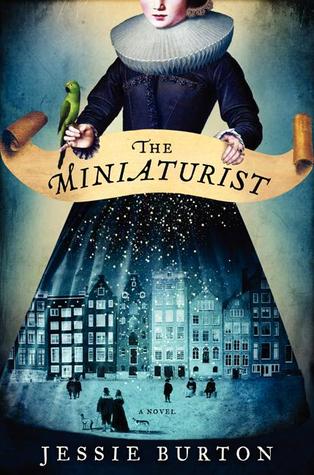
The Miniaturist by Jessie Burton

          I have recently read the book: The Miniaturist. The story takes place in Amsterdam, Holland during the late 1600s. The main character, Petronella "Nella" Oortman, is from a semi-influential family riddled with her late father's debts. Nella's mother arranges for her to marry into the single most influential family, that of Johannes Brandt, a wealthy Dutch trader. Johannes seems a bit distant at first, and his sister a bit aloof. The staff of the house was just a mysterious, no one willing to betray each other to the new mistress of the house.

The cabinet house of Petronella de la Court. It gave Jessie Burton the inspiration for the book.


          As the story progresses, Brandt gives Nella a beautifully detailed cabinet house as a wedding gift, similar to a doll house. At first Nella feels slighted, as if Johannes' present was to mock her young age. Then she realizes that the house was actually an exact replica of their own house. Nella decides to furnish her cabinet house by finding a listing for the titular character, the miniaturist. The miniaturist is a shadowy figure that at first remains a mystery. Petronella writes to the miniaturist, requesting specific pieces, and the miniaturist produces the desired furniture. But there's a catch. The miniaturist also produces extra pieces. These pieces were not requested, and bared an uncanny resemblance to things within the Brandt household. Nella is understandably perplexed and worried, but at the same time curious, just as anyone would be. As the plot deepens though, a darker element is revealed. 

          Overall, the book was very enjoyable. It was a light read that kept me engaged with suspense. Although it was slightly predictable, I would definitely recommend this book to anyone. A main element of the story that could be improved would be the focus. Jessie Burton broaches many of the controversial topics of the time, some still controversial: racism, homosexuality, as well as women's rights. Also, the main character is not very well developed. A supporting character, Marin Brandt, is characterized very well though, enough to make up for the lacking of a strong main character.





Friday, December 5, 2014

I Am Malala by Malala Yousafzai #3 - Finished

          Recently, I have finished the book I Am Malala. It has been a very eye opening story. It's hard to imagine that the basic rights of people could be exploited so much. Here in the US, we take our education for granted, constantly complaining about tests and assignments. Over in Pakistan, Malala's desire for an education and her passion for equality almost came at the price of her life.

          Malala describes in her story, how education wasn't the aspect of life being censored and controlled. While at the bazaar (market), her mother and her cousin were nearly attacked simply for not covering their faces. 

          The situation continued to worsen, and seems that this is the result of fear. The people of Pakistan was afraid of the potential repercussions of speaking against the Taliban, and speaking against the government. Malala's father was one of the few ready to step up and let his voice be heard. In fact, he even attempted to rally peoples' support against the Taliban. A poem by Martin Niemöller was referenced to:

"First they came for the communists,
and I didn't speak out because I wasn't a communist.
Then they came for the socialists, 
and I didn't speak out because I wasn't a socialist.
They they came for the trade unionists,
and I didn't speak out because I wasn't a trade unionist.
Then they came for the Jews, 
and I didn't speak out because I was not a Jew.
Then they came for the Catholics,
and I didn't speak out because I was not a Catholic. 
Then they came for me,
and there was no one left to speak for me"
(Yousaifzai, 73).

          Niemöller had lived in Nazi Germany. As I mentioned in my last post, there are some similarities between the two situations. In both cases, further catastrophe could have been avoided had someone shouted out in protest. Silence is almost as worse as support, since in staying neutral, lives are lost.

          Overall, I Am Malala is definitely a book I would recommend to just about anyone. It really opens one's eyes to the current state of the world, and emphasizes just how free we really are in the US. It forces us to appreciate the small things that we currently take for granted, since in other countries, people are actually dying to achieve equality for all.


Friday, November 21, 2014

I Am Malala by Malala Yousafzai #2

          This week I continued to read I Am Malala. Malala continues to describe the only worsening situation in Pakistan. She has introduced the character Maulana Fazlullah. He is a Taliban supporter and is educated in the Muslim works (the term Malala uses is Mullah). He started a radio station where he began to preach. At first, Fazlullah was simply telling the residents of the Swat Valley to stick to good habits, and to drop the bad ones. With every turn of the page, the Mullah's teachings became more and more controversial. He began to criticize female education, (a subject central to the book, and one of Malala's core beliefs). He publicly announced and congratulated girls that dropped out of school. For many though, this brought up the question, why?

"My friends and I couldn't understand why it was so wrong. 'Why don't they want girls to go to school?' I asked my father. 'They are scared of the pen,' he replied," (Yousafzai, 62)

          This brought back the idea that an education could be dangerous. It allows people to comprehend ideas and form an opinion. Opinions can be very dangerous in a society built on ignorance.

The Mullah continued to radicalize the people. He went as far as to ban women from leaving their homes. He also banned shaving and barbershops. By the time these radical ideas were heard, Fazlullah had already gained a large amount of support.

Nazis burning books
          The Mullah's bans continued to become more and more aggressive. He began to ban television, music, and dancing. With the Taliban's help, he collected all of the TV's and CDs, and burned them. With this I find an eery similarity to the Nazi book burnings. Both events were to censor the media. To maintain the ignorance of the people. In the mid 1900s, books were the source of information. In the late 20th century/early 21st century, prominence switched over to the television. That might be why unlike the Nazis, the Taliban left the books alone.

         Fazlullah didn't stop there. He began to build Madrasas (Muslim schools) and Mosques (Muslim places of worship), with the people's money and labor. He required each town to send its men for a day in order to work on the construction. Fazlullah's teachings begins to infiltrate even Malala's school. Male teachers began to refuse teaching to female students. It is almost unfathomable what a charismatic leader can accomplish. Once again, similarities can be found between Fazlullah and the Nazis, specifically Hitler. Both leaders managed to exploit the ignorance of their people in order to accomplish the spreading of their ideology.


Friday, November 14, 2014

I Am Malala by Malala Yousafzai #1

          Recently I have started the autobiography of Nobel Peace Prize laureate, Malala Yousafzai. The Taliban had attempted to assassinate her for standing up for women's education in her homeland Pakistan. Malala survived and continues to be an activist for women's rights.

          What I find to be shocking, is that a country would discourage education. An education allows someone to better their own life, as well as the lives of others. As Nelson Mandela once said:

"Education is the most powerful weapon which you can use to change the world" 
- Nelson Mandela

          I feel as if that's the exact reason why an education was frowned upon. Here in America, an education is fundamental to success. We are taught to do well in school, so that we can have a better future. Our country's ideology also play a big part in this. America has always been considered to be a land where one could freely follow their dreams. A land where freedom is in the very air we breathe. Our democracy is another manifestation of this freedom. 

          Malala elaborates with great detail how Pakistan, being a fairly young country, has suffered years of martial rule. Many attempts at a democracy were halted by a dictatorship. Malala describes how her father believed that an ignorant nation only benefitted the politicians trying to retain power:

"Education had been a great gift for him. He believed that lack of education was the root of all Pakistan’s problems. Ignorance allowed politicians to fool people and bad administrators to be re-elected" 
(Yousafzai, 26).

          This was the condition of Pakistan as a nation. It was almost unfathomable to believe that women actually had it much worse, to the point where a 15 year old girl was shot simply because she wanted to learn. She elaborates on how her nation has the wrong view of things. In the Swat Valley where she is from, a women's place is in the house. Cooking and cleaning, but nothing monumental. This was the same ideology that was prevalent in even America at one point. What I find extraordinary, is that Malala still found a way to rise above her challenges. She stayed true to her beliefs, and vowed to bring change to her country. This is hard enough as it is, but almost Herculean when even her country tries to silence her with a bullet to the shoulder. 

          A quarter through the book, I find Malala's story to be very inspirational. Her family started off penniless. Her father had nothing but the dream to open a school. Despite the setbacks, his determination prevailed. This same determination is evident in his daughter, Malala. Malala was eventually recognized for her work, and awarded the Nobel Peace Prize, which you can read about here.


Thursday, November 13, 2014

Code Name Verity by Elizabeth Wein #4 *SPOILERS* - Finished

          In case you didn't read the title, there will be spoilers. So if you haven't finished the book: LEAVE NOW. I will literally ruin the entire ending in the following paragraphs. Continue reading only if you read the story, or if you simply don't mind me spoiling it for you. 

          Maddie's alive. This was a totally unexpected turn of events. The narrations continue in the same time frame, only now, Maddie Brodatt's the narrator. Her writing style is a stark contrast to the well educated and sophisticated Julie. Maddie's writing incorporates a lot of Scottish slang, since she grew up on the streets of Scotland. Maddie's toughened up personality also shines through in her writing. 

          This is definitely bordering the climax in the story. The true climax was yet to come at this point, but dead Maddie being alive was definitely an unpredictable plot twist. From here though, everything just goes downhill. The pieces all fit together like a puzzle.

          Maddie did in fact crash land, but she didn't die as we were led to believe. She was found by the resistance in France, and her place in the decimated cockpit was taken by the dead pilot of another wreckage (*sigh*, if only Julie had known that). Maddie assumes an alternate identity while being undercover in France, and she also stays with another family connected with the resistance. Here's the part where my jaw dropped, the family Maddie stays with, was named Thibaut. The eldest son in the family, Etienne Thibaut, was a Gestapo officer. The same Gestapo officer in charge of torturing Julie. Also, it is revealed later on that Anna Engel, one of the other prison officers, was actually another member of the resistance. Adding to that, it is also revealed that Julie was not a traitor. Every piece of classified information she gave to the Gestapo, was a lie. Is there anyone we can trust in this book? 

          So Maddie continues staying undercover in Ormaie, France, when all of a sudden Julie's position is apparent. Maddie is overwhelmed with emotions of joy and despair. She is thankful for her best friend being alive, but still realizes that she might not be for much longer. The resistance plans an attack on the prison, but alas, it was not to be as planned. The reader expects Maddie to rescue her best friend, and for them to remain friends at the conclusion of the war, but no, that's much too happy of an ending. 

          Julie dies. Not at the hands of the Gestapo. She wasn't executed, and she wasn't the victim of enemy fire, or even accidental shooting from her own side. Julie's death was truly the climax. It was the most heartbreaking thing that could happen, yet it was fitting. Julie dies, because Maddie shoots her. On purpose. 

          The only justification was that Julie was going to die anyways. The prisoners were all having limbs blown off, and then a bullet to the heart. Maddie couldn't let Julie leave that way. The one true moment were the reader could feel closure in, was that Julie finally saw Maddie again. The story had come full circle, but only to end in tragedy. Her last words were:

“KISS ME, HARDY! Kiss me, QUICK!" (Wein, 412)

          These were the same words she told Maddie before jumping out of that airplane. Maddie knew what Julie wanted, and she followed through. In this one moment, the reader could truly see the extent of their friendship. They were the best of friends, to the point where Maddie killed Julie, out of an almost sisterly love.

          Although some parts of the book were annoyingly boring, Code Name Verity is worth reading. It is one of the few books I have come across, that truly represent the power of a strong friendship. (Also my apologies for this crazy long post...) This link takes you to the Goodreads page for the book.


Wednesday, November 12, 2014

Code Name Verity by Elizabeth Wein #3 *SPOILERS*

          This week, as I read, my predictions were proven to be correct. The character Queenie is in fact Verity herself. Verity, in order to avoid directly describing herself, disguised herself as another character. This added an element of foreshadowing to the story. The Hauptsturmführer (commanding SS officer at the Nazi prison) was the one to see the similarities between Verity and Queenie.

          Another development in the story was an implication that Verity's best friend, and the main character of the flashbacks, Maddie, might not have survived the crash landing. The author doesn't go too deep into the details, allowing the reader to infer for themselves whether Maddie is truly dead or not (this also adds the element of suspense). For a few of the following chapters, the story became relatively boring. I almost quit reading. There was too much info on Maddie's flight and etcetera. Eventually, another highlight came along. Vertiy's cellmate (not really cellmate, more of a jail neighbor) was sent to the guillotine. This was the first actual execution in the book. I mean, in a story about World War II, people are definitely going to die.. but this was the first execution that actually meant something. Okay, that sounded heartless. What I mean is that the execution of the French prisoner Marie, was kind of a reality check. It brings back the possibility that Verity might actually die. So far, the author has built up a mutual understanding between Verity and the Hauptsturmführer, but this execution brings up the idea that our beloved main character, might end up dead.

          Also, Verity finally revealed her real name (Wow, that's a huge jump from the first paragraph.. I did a lot of reading). This doesn't seem to be very important, but it is. She's been called Scottie, Queenie, Eva, Scheherazade (by von Lindon), and Verity. All of those names are referring to the same flight officer, but not once has she actually mentioned her true name. As Queenie/A whole bunch of other names, reaches the conclusion of her story, she finally reveals it. Lady Julia Lindsay MacKenzie Wallace Beaufort-Stuart. It's quite a regal name. She also mentions that she preferred to be called Julie, with no titles. This revelation also reveals a lot about her characterization. She comes from a powerful family (LADY Julia), she's well educated, and grew up in castle, yet she doesn't exploit her position. Verity, or as I should say, Julie, doesn't care for the lavish lifestyle her family undoubtedly enjoys. She doesn't want to make use of her family name, and instead wants to create a name for herself. Julie wants to be known for what she does, not her family (it's quite impressive how much one simple sentence can reveal). Further analysis of Julie can be found here. Well, I will continue reading and hope that the story becomes more interesting now that Julie's story is finished. The original deal was that she would write, and then be executed, so I am quite curious as to why there's a good 150 pages left.


Tuesday, October 14, 2014

Code Name Verity by Elizabeth Wein #2 *SPOILERS*

          This week I have continued reading the book Code Name Verity. As I read further into the story, the character development and plot become more evident. In the past week, Verity describes how her best friend Maddie learned how to fly a plane, and gradually worked her way up the ranks while assisting the British war efforts during World War II. Verity describes how Maddie become a respected radar operator, and how she helped land and navigate many of the planes. Verity also describes being tortured by the officers at the prison, Engel and Thibaut.

          A part that stood out to me was the introduction of a new character, Queenie. Queenie comes from a privileged family, and she has studied in Switzerland. Verity explains how Maddie took an instant liking to Queenie, and how the two gradually became friends. What strikes me is that Verity still has not mentioned how she herself fits into the plot. The book is supposed to show how Verity and Maddie's friendship prevailed, but Maddie seems to be growing attached to Queenie. As the reader, I can infer that Queenie and Verity might actually be one and the same. As I continue to read, it will become evident whether my predictions are correct or not.

          An interesting element in Code Name Verity would be the plot structure. There is in fact two plots occurring at the same time. This is similar to the book we are reading in class, The Color of Water by James McBride. In The Color of Water, McBride narrates the present tense, while his mother narrates the past tense. In Code Name Verity, Verity's perspective narrates her current imprisonment, while Maddie's perspective, narrates the past. This allows the reader to observe two plots at the same time. It also adds a greater meaning to the past tense, since it will eventually explain why some things are true in the present, such as how Verity came to be in her current predicament.


Saturday, October 4, 2014

Code Name Verity by Elizabeth Wein #1

          This week I have started the book Code Name Verity. It is historical fiction, which is a genre that I don't usually read. It is an epistolary novel chronicling the memories of the main character, who recalls her best friend Maddie. They both are British spies during World War II. After receiving enemy fire while flying over France, the two are split apart. Maddie forces Verity out of the plane leaving her to attempt a landing on her own. Verity is captured by the Nazis occupying France, and is now being tortured into giving up information. 
     
          Verity agrees to divulge information in a desperate barter to safe her life. Since Verity and the commanding officer of the prison have a language barrier, Hauptsturmführer Von Linden orders Verity to divulge the secrets through writing that could be later translated by the assistant, Anna Engel. Verity decides that if she was to become a traitor, she wouldn't make it blatant. So, she reveals information through the course of her letters to Von Linden. She begins to intricately weave the confidential details into her writing. 

          As I have just recently started this book, the true plot-line has not developed. So far nothing important has happened yet since the author is currently establishing the setting and properly introducing the characters. I will continue reading though, due to the interesting summary. The story emphasizes the power of friendship, not romance as most novels would. I am excited to continue reading, and to find out what happens next.


     The following is the official UK book trailer for Code Name Verity


Friday, September 26, 2014

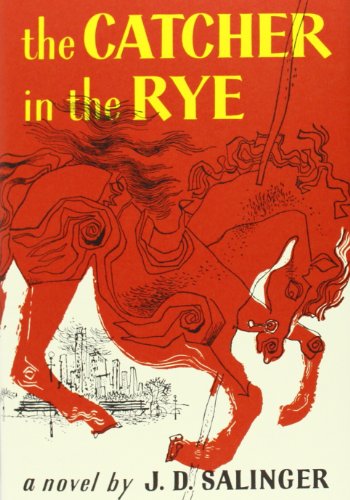
The Catcher in the Rye by J. D. Salinger #3 - Finished

          This week I finished the book The Catcher in the Rye. In the last third of the book, the main character Holden begins to express signs that he's scared about his future. Holden spends the remaining pages trying to find himself, but he still feels lost. While out on a date with his friend, Holden decides to leave his home and essentially run away. He wants to escape his problems, and simply go to some place where he can get a fresh start.

          Although Holden never actually describes himself as lost, one can infer that he is still trying to find who he is. Throughout the story he describes most characters, mainly adults, as "phonies". Holden seems to truly consider only himself and his sister to be anything other than fake. While acknowledging this point, the reader could infer that Holden is trying to convey that he doesn't belong in this society, and that this is not the identity he wanted for himself. One could also understand that Holden considers becoming a phony to be part of growing up. This may be why he is reluctant to do so. On many occasions, Holden mentions how his brother D. B. became a "sellout" when he grew up and became a writer. This personal experience may explain Holden's pessimistic view of growing up.

          When Holden was asked by his sister Phoebe about what he wanted to become, his response was a very pivotal moment in the story:

"What I have to do, I have to catch everybody if they start to go over the cliff--I mean if they're running and they don't look where they're going I have to come out from somewhere and catch them. That's all I'd do all day. I'd just be the catcher in the rye and all. I know it's crazy, but that's the only thing I'd really like to be. I know it's crazy," (Salinger, 93).


       In the lines stated above, one can truly see that Holden Caulfield is a lost soul. He sympathizes with those in similar situations, and has decided that he'd want to help. Similar to the people Holden described in the quote, he is also someone who is running without looking. He is simply getting by in life, but has no idea where his path may take him.  

          Overall I enjoyed this book, and I found the stream of consciousness structure to be different and refreshing, since it is not seen often in the books I read. I also liked how a reader could interpret the central message in many different ways. It all depends on which inferences they made. For example, this link takes you to an article on analyzing the reason why Holden is the way he is. 


Friday, September 19, 2014

The Catcher in the Rye by J.D. Salinger #2

          This week I continued reading J.D. Salinger's The Catcher in the Rye. As I read, I noticed that most of the story is found in the main character, Holden's memories. The story itself takes place in the span of a few days, but Salinger adds more depth by describing Holden's past through the narration of his memories.

          The main character Holden Caulfield reminds me of Charlie from Stephen Chbosky's The Perks of Being a Wallflower. Both Holden and Charlie seem to be very indifferent towards things usually filled with more excitement. In Chbosky's novel, other characters even tell Charlie that he is a wallflower. In The Catcher in the Rye this characterization is more subtle, and told through Holden's thoughts, actions, and words. This characterization is also realized since Holden seems to always be lost in thought. A key difference between the two characters is that Holden seems to reject society, and desires one more suited to him. He is extremely introverted, and perceives society to be filled with 'phonies'. Charlie on the other hand seems to find himself naturally fitting in with a crowd of outcasts. They face similar struggles, but have different approaches when it comes to dealing with them.

          I am a third of the way through the book, and I'm finding the story to be very interesting. There is no real action, since the conflict is more internal than external. Holden often refers back to the death of his older brother Allie. Through this the reader can recognize that Holden is still coping with Allie's death, and seems to be coping with growing up in general.


Friday, September 12, 2014

The Catcher in the Rye by J. D. Salinger #1

          Recently I have started the book The Catcher in the Rye. The plot has not developed yet, but the introduction seems interesting. The main character, Holden Caulfield is an apathetic teenager who is kicked out of his fourth school. He believes that this is all just a phase, and that everything will turn out okay, but his history teacher Mr. Spencer thinks differently. Holden's main problem is that he doesn't apply himself, and he believes that everything is too 'phony'. So far the story is a narration of life through a teenager's perspective.

          Salinger does an amazing job with the characterization. He clearly depicts the character without having to literally state a description. In the following lines Holden is describing his brother D. B. They are an example of how Salinger uses slang terms and basic vocabulary to express the thoughts and feelings of a teenager:

          "He's in Hollywood. That isn't too far from this crumby place, and he comes over and visits me practically every week end. He's going to drive me home when I go home next month maybe. He just got a Jaguar. One of those little English jobs that can do around two hundred miles an hour. It cost him... near four thousand bucks. He's got a lot of dough, now. He didn't use to," (Salinger, 1)

          The use of words like 'crumby' and 'dough' (instead of money) makes the reader imagine a bored, Type B personality, which is exactly what Holden is.

          I have just started this book, but I already enjoy reading it. The language used in the book is different from what one would usually expect from a book written in 1951, which makes it interesting. I can already tell why Salinger's novel is considered a classic, and I expect to continue with this book.


The following is an artist's representation of Holden Caulfield. The link is also an analysis of Holden's personality.


Wednesday, September 3, 2014

The Sea of Tranquility by Katja Millay

          Recently I have read the book The Sea of Tranquility. It is essentially a love story between two people who are tormented by themselves. The author tells this story from the perspectives of the two main characters. Nastya feels as if the real her has died and that she is only a ghost of who she used to be. Josh is living alone at the age of seventeen since everyone he has known and loved were taken from him at an early age. They both are sucked into a depression and simply try to get by in life.
         
          Nastya switches to Josh's school with the one goal of blending in and remaining unnoticed. She is vengeful and wants to destroy the boy that destroyed her. She wants justice for what happened to her, but the only problem is that she doesn't talk. To anyone. The people at her school avoid her, but a few manage to slip through her defenses and befriend her. As she makes new friends she creates a new identity for herself, and begins to feel less damaged. She finds herself growing attached towards
Josh, the boy in her woodshop class. She learns that she is not the only one struggling. With Josh, she finds her voice and the part of herself she thought she had lost.

          Josh was alone and content with it. He had no one to love, and no one loved him back. His mother and sister went first, and then his dad. His grandmother soon followed, and it was only days before cancer took his grandfather as well. Josh had all the money one could need, but at the cost of his family. When Nastya suddenly appears and seems to be more damaged than him, Josh begins to come out of his shell. He starts a friendship with Nastya that soon evolves into something more.

          The story takes the form of a W-plot. There are ups, and then there are downs. There's no steady incline that ends predictably. This plot structure fits the story since it keeps it interesting. Just when you think there is falling action, the plot rises again and there is a new problem to be resolved. The suspense is also sustained since the details of Nastya's past are slowly revealed in fragments, and only at the end does everything come together in a final climax.

          Overall, I found the book to be interesting and enjoyable. The suspense is what compelled me to keep reading. The only downside is that I found the character Nastya to be a little too pessimistic and blind to opportunities. She wanted justice for what happened to her, but she refused to speak to anyone. Despite that, I would still recommend this book.


Thursday, August 21, 2014

Pure by Julianna Baggott

          I have read the book Pure over summer. It is set in a dystopian future society in the remains of an Earth destroyed by warfare. There are two main settings, one is the Dome, and the other is the land outside. The Dome was a structure built to save a select group of people in case of extreme destruction due to warfare. This did indeed occur soon after the Dome's completion, in an event known as the Detonations. Most of the people who were denied access to the Dome were killed during the Detonations. The survivors were "fused" to other objects, animals, people, or the Earth itself. These survivors have to live in nearly inhabitable conditions, and despise the people inside of the Dome, known as Pures. The Pures are led by Ellery Willux, a politician who was responsible for the Dome's construction. Willux's son Partridge begins to suspect that his father is hiding secrets, and escapes the Dome. Partridge and the other main characters then go on a mission to take down the Dome and unify the two populations. 

          There are many dynamic characters, but I have chosen to write about the character El Capitan. At the beginning of the story Cap was an OSR officer. The OSR controls the people outside of the Dome. It is later understood that they are under the control of Ellery Willux. As an officer, El Capitan had murdered thousands of people, and felt no remorse. He was very violent and disrespectful towards his brother Helmud, who he is permanently fused to. As the story progressed, El Capitan began to show a softer side, and started to value others more than he used to. He forms friendships with the other characters and begins to show respect for his brother. These are both things that would seem out of character at the beginning of the book. A major sign of El Capitan's transformation was when Helmud saved himself and Cap from the soldiers trying to kill them: "For the first time in as long as he can remember, El Capitan is proud of his brother," (Baggott, 392). This quote shows how Cap's attitude towards his brother is finally changing, which also means that his personality is going through a similar transformation.

          Overall, I enjoyed the book Pure. I like reading about dystopian societies, and that is the setting for Pure. The story is different from the other books in this genre since it provides us with main characters who are far from perfect. The character Bradwell accepts his fusings as a sign of survival, while the character Pressia is torn between accepting her fusings and wanting them to be gone. Another element that helps Pure stand out is that the book puts great emphasis on how the Earth became this post-apocalyptic habitat, while most other books only summarize those events.


          Here is the New York Times' review of Pure. The NY Times provide a summary of the book, as well as an analysis of the characters.