Friday, November 21, 2014

I Am Malala by Malala Yousafzai #2

          This week I continued to read I Am Malala. Malala continues to describe the only worsening situation in Pakistan. She has introduced the character Maulana Fazlullah. He is a Taliban supporter and is educated in the Muslim works (the term Malala uses is Mullah). He started a radio station where he began to preach. At first, Fazlullah was simply telling the residents of the Swat Valley to stick to good habits, and to drop the bad ones. With every turn of the page, the Mullah's teachings became more and more controversial. He began to criticize female education, (a subject central to the book, and one of Malala's core beliefs). He publicly announced and congratulated girls that dropped out of school. For many though, this brought up the question, why?

"My friends and I couldn't understand why it was so wrong. 'Why don't they want girls to go to school?' I asked my father. 'They are scared of the pen,' he replied," (Yousafzai, 62)

          This brought back the idea that an education could be dangerous. It allows people to comprehend ideas and form an opinion. Opinions can be very dangerous in a society built on ignorance.

The Mullah continued to radicalize the people. He went as far as to ban women from leaving their homes. He also banned shaving and barbershops. By the time these radical ideas were heard, Fazlullah had already gained a large amount of support.

Nazis burning books
          The Mullah's bans continued to become more and more aggressive. He began to ban television, music, and dancing. With the Taliban's help, he collected all of the TV's and CDs, and burned them. With this I find an eery similarity to the Nazi book burnings. Both events were to censor the media. To maintain the ignorance of the people. In the mid 1900s, books were the source of information. In the late 20th century/early 21st century, prominence switched over to the television. That might be why unlike the Nazis, the Taliban left the books alone.

         Fazlullah didn't stop there. He began to build Madrasas (Muslim schools) and Mosques (Muslim places of worship), with the people's money and labor. He required each town to send its men for a day in order to work on the construction. Fazlullah's teachings begins to infiltrate even Malala's school. Male teachers began to refuse teaching to female students. It is almost unfathomable what a charismatic leader can accomplish. Once again, similarities can be found between Fazlullah and the Nazis, specifically Hitler. Both leaders managed to exploit the ignorance of their people in order to accomplish the spreading of their ideology.


Friday, November 14, 2014

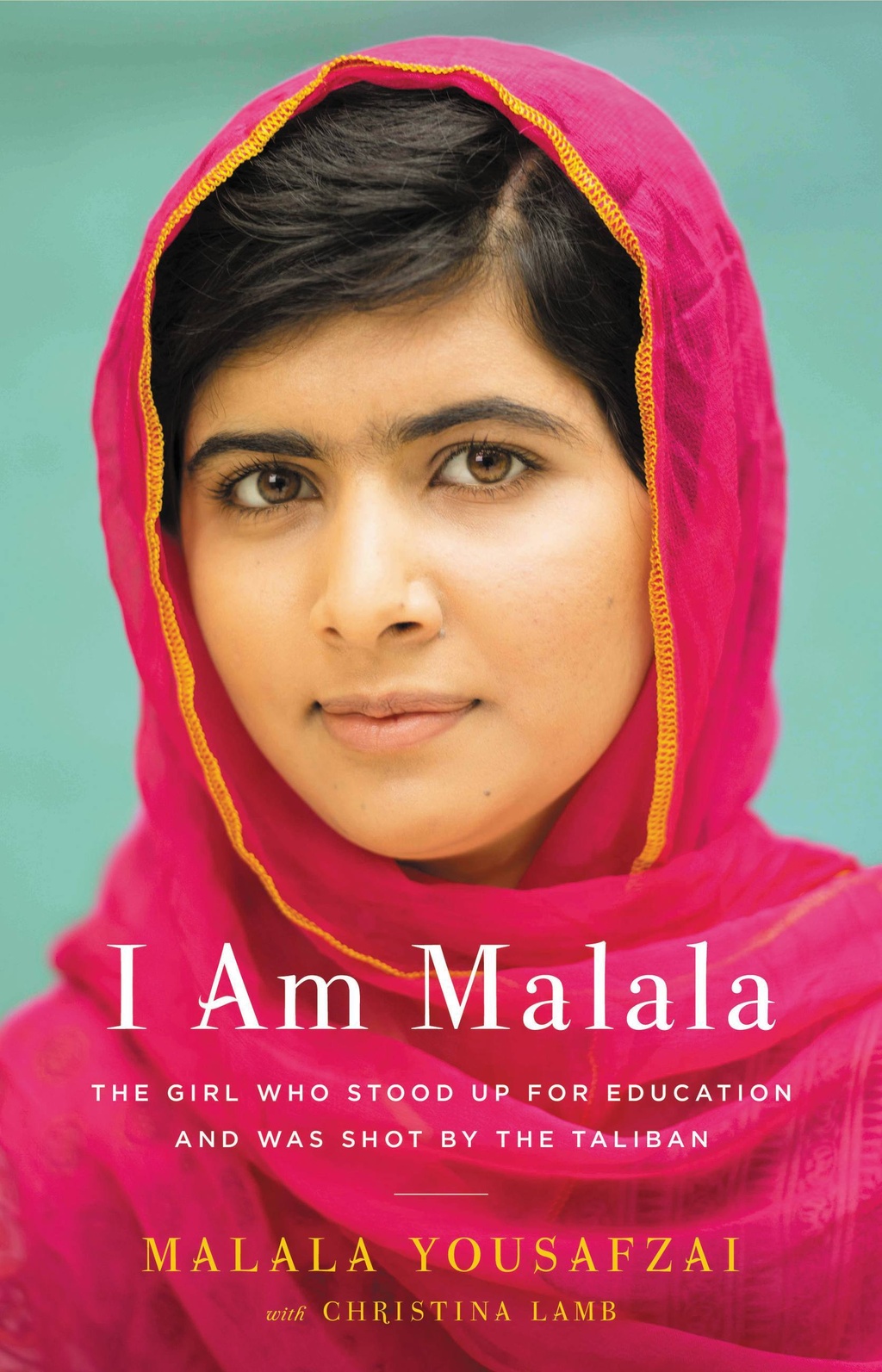
I Am Malala by Malala Yousafzai #1

          Recently I have started the autobiography of Nobel Peace Prize laureate, Malala Yousafzai. The Taliban had attempted to assassinate her for standing up for women's education in her homeland Pakistan. Malala survived and continues to be an activist for women's rights.

          What I find to be shocking, is that a country would discourage education. An education allows someone to better their own life, as well as the lives of others. As Nelson Mandela once said:

"Education is the most powerful weapon which you can use to change the world" 
- Nelson Mandela

          I feel as if that's the exact reason why an education was frowned upon. Here in America, an education is fundamental to success. We are taught to do well in school, so that we can have a better future. Our country's ideology also play a big part in this. America has always been considered to be a land where one could freely follow their dreams. A land where freedom is in the very air we breathe. Our democracy is another manifestation of this freedom. 

          Malala elaborates with great detail how Pakistan, being a fairly young country, has suffered years of martial rule. Many attempts at a democracy were halted by a dictatorship. Malala describes how her father believed that an ignorant nation only benefitted the politicians trying to retain power:

"Education had been a great gift for him. He believed that lack of education was the root of all Pakistan’s problems. Ignorance allowed politicians to fool people and bad administrators to be re-elected" 
(Yousafzai, 26).

          This was the condition of Pakistan as a nation. It was almost unfathomable to believe that women actually had it much worse, to the point where a 15 year old girl was shot simply because she wanted to learn. She elaborates on how her nation has the wrong view of things. In the Swat Valley where she is from, a women's place is in the house. Cooking and cleaning, but nothing monumental. This was the same ideology that was prevalent in even America at one point. What I find extraordinary, is that Malala still found a way to rise above her challenges. She stayed true to her beliefs, and vowed to bring change to her country. This is hard enough as it is, but almost Herculean when even her country tries to silence her with a bullet to the shoulder. 

          A quarter through the book, I find Malala's story to be very inspirational. Her family started off penniless. Her father had nothing but the dream to open a school. Despite the setbacks, his determination prevailed. This same determination is evident in his daughter, Malala. Malala was eventually recognized for her work, and awarded the Nobel Peace Prize, which you can read about here.


Thursday, November 13, 2014

Code Name Verity by Elizabeth Wein #4 *SPOILERS* - Finished

          In case you didn't read the title, there will be spoilers. So if you haven't finished the book: LEAVE NOW. I will literally ruin the entire ending in the following paragraphs. Continue reading only if you read the story, or if you simply don't mind me spoiling it for you. 

          Maddie's alive. This was a totally unexpected turn of events. The narrations continue in the same time frame, only now, Maddie Brodatt's the narrator. Her writing style is a stark contrast to the well educated and sophisticated Julie. Maddie's writing incorporates a lot of Scottish slang, since she grew up on the streets of Scotland. Maddie's toughened up personality also shines through in her writing. 

          This is definitely bordering the climax in the story. The true climax was yet to come at this point, but dead Maddie being alive was definitely an unpredictable plot twist. From here though, everything just goes downhill. The pieces all fit together like a puzzle.

          Maddie did in fact crash land, but she didn't die as we were led to believe. She was found by the resistance in France, and her place in the decimated cockpit was taken by the dead pilot of another wreckage (*sigh*, if only Julie had known that). Maddie assumes an alternate identity while being undercover in France, and she also stays with another family connected with the resistance. Here's the part where my jaw dropped, the family Maddie stays with, was named Thibaut. The eldest son in the family, Etienne Thibaut, was a Gestapo officer. The same Gestapo officer in charge of torturing Julie. Also, it is revealed later on that Anna Engel, one of the other prison officers, was actually another member of the resistance. Adding to that, it is also revealed that Julie was not a traitor. Every piece of classified information she gave to the Gestapo, was a lie. Is there anyone we can trust in this book? 

          So Maddie continues staying undercover in Ormaie, France, when all of a sudden Julie's position is apparent. Maddie is overwhelmed with emotions of joy and despair. She is thankful for her best friend being alive, but still realizes that she might not be for much longer. The resistance plans an attack on the prison, but alas, it was not to be as planned. The reader expects Maddie to rescue her best friend, and for them to remain friends at the conclusion of the war, but no, that's much too happy of an ending. 

          Julie dies. Not at the hands of the Gestapo. She wasn't executed, and she wasn't the victim of enemy fire, or even accidental shooting from her own side. Julie's death was truly the climax. It was the most heartbreaking thing that could happen, yet it was fitting. Julie dies, because Maddie shoots her. On purpose. 

          The only justification was that Julie was going to die anyways. The prisoners were all having limbs blown off, and then a bullet to the heart. Maddie couldn't let Julie leave that way. The one true moment were the reader could feel closure in, was that Julie finally saw Maddie again. The story had come full circle, but only to end in tragedy. Her last words were:

“KISS ME, HARDY! Kiss me, QUICK!" (Wein, 412)

          These were the same words she told Maddie before jumping out of that airplane. Maddie knew what Julie wanted, and she followed through. In this one moment, the reader could truly see the extent of their friendship. They were the best of friends, to the point where Maddie killed Julie, out of an almost sisterly love.

          Although some parts of the book were annoyingly boring, Code Name Verity is worth reading. It is one of the few books I have come across, that truly represent the power of a strong friendship. (Also my apologies for this crazy long post...) This link takes you to the Goodreads page for the book.


Wednesday, November 12, 2014

Code Name Verity by Elizabeth Wein #3 *SPOILERS*

          This week, as I read, my predictions were proven to be correct. The character Queenie is in fact Verity herself. Verity, in order to avoid directly describing herself, disguised herself as another character. This added an element of foreshadowing to the story. The Hauptsturmführer (commanding SS officer at the Nazi prison) was the one to see the similarities between Verity and Queenie.

          Another development in the story was an implication that Verity's best friend, and the main character of the flashbacks, Maddie, might not have survived the crash landing. The author doesn't go too deep into the details, allowing the reader to infer for themselves whether Maddie is truly dead or not (this also adds the element of suspense). For a few of the following chapters, the story became relatively boring. I almost quit reading. There was too much info on Maddie's flight and etcetera. Eventually, another highlight came along. Vertiy's cellmate (not really cellmate, more of a jail neighbor) was sent to the guillotine. This was the first actual execution in the book. I mean, in a story about World War II, people are definitely going to die.. but this was the first execution that actually meant something. Okay, that sounded heartless. What I mean is that the execution of the French prisoner Marie, was kind of a reality check. It brings back the possibility that Verity might actually die. So far, the author has built up a mutual understanding between Verity and the Hauptsturmführer, but this execution brings up the idea that our beloved main character, might end up dead.

          Also, Verity finally revealed her real name (Wow, that's a huge jump from the first paragraph.. I did a lot of reading). This doesn't seem to be very important, but it is. She's been called Scottie, Queenie, Eva, Scheherazade (by von Lindon), and Verity. All of those names are referring to the same flight officer, but not once has she actually mentioned her true name. As Queenie/A whole bunch of other names, reaches the conclusion of her story, she finally reveals it. Lady Julia Lindsay MacKenzie Wallace Beaufort-Stuart. It's quite a regal name. She also mentions that she preferred to be called Julie, with no titles. This revelation also reveals a lot about her characterization. She comes from a powerful family (LADY Julia), she's well educated, and grew up in castle, yet she doesn't exploit her position. Verity, or as I should say, Julie, doesn't care for the lavish lifestyle her family undoubtedly enjoys. She doesn't want to make use of her family name, and instead wants to create a name for herself. Julie wants to be known for what she does, not her family (it's quite impressive how much one simple sentence can reveal). Further analysis of Julie can be found here. Well, I will continue reading and hope that the story becomes more interesting now that Julie's story is finished. The original deal was that she would write, and then be executed, so I am quite curious as to why there's a good 150 pages left.