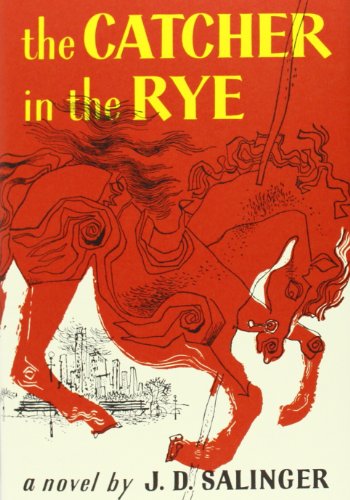
Recently I have started the book The Catcher in the Rye. The plot has not developed yet, but the introduction seems interesting. The main character, Holden Caulfield is an apathetic teenager who is kicked out of his fourth school. He believes that this is all just a phase, and that everything will turn out okay, but his history teacher Mr. Spencer thinks differently. Holden's main problem is that he doesn't apply himself, and he believes that everything is too 'phony'. So far the story is a narration of life through a teenager's perspective.
Salinger does an amazing job with the characterization. He clearly depicts the character without having to literally state a description. In the following lines Holden is describing his brother D. B. They are an example of how Salinger uses slang terms and basic vocabulary to express the thoughts and feelings of a teenager:
The use of words like 'crumby' and 'dough' (instead of money) makes the reader imagine a bored, Type B personality, which is exactly what Holden is.
I have just started this book, but I already enjoy reading it. The language used in the book is different from what one would usually expect from a book written in 1951, which makes it interesting. I can already tell why Salinger's novel is considered a classic, and I expect to continue with this book.
%2B(2).jpg)
Salinger does an amazing job with the characterization. He clearly depicts the character without having to literally state a description. In the following lines Holden is describing his brother D. B. They are an example of how Salinger uses slang terms and basic vocabulary to express the thoughts and feelings of a teenager:
"He's in Hollywood. That
isn't too far from this crumby place, and he comes over and visits me practically every
week end. He's going to drive me home when I go home next month maybe. He just got a
Jaguar. One of those little English jobs that can do around two hundred miles an hour. It
cost him... near four thousand bucks. He's got a lot of dough, now. He didn't use to," (Salinger, 1)
The use of words like 'crumby' and 'dough' (instead of money) makes the reader imagine a bored, Type B personality, which is exactly what Holden is.
I have just started this book, but I already enjoy reading it. The language used in the book is different from what one would usually expect from a book written in 1951, which makes it interesting. I can already tell why Salinger's novel is considered a classic, and I expect to continue with this book.
The following is an artist's representation of Holden Caulfield. The link is also an analysis of Holden's personality.

Ranjani,
ReplyDeleteThis book seems very interesting, with well developed characters and a complex plot. I like how you incorporated a quote into your blog post to support your analysis.